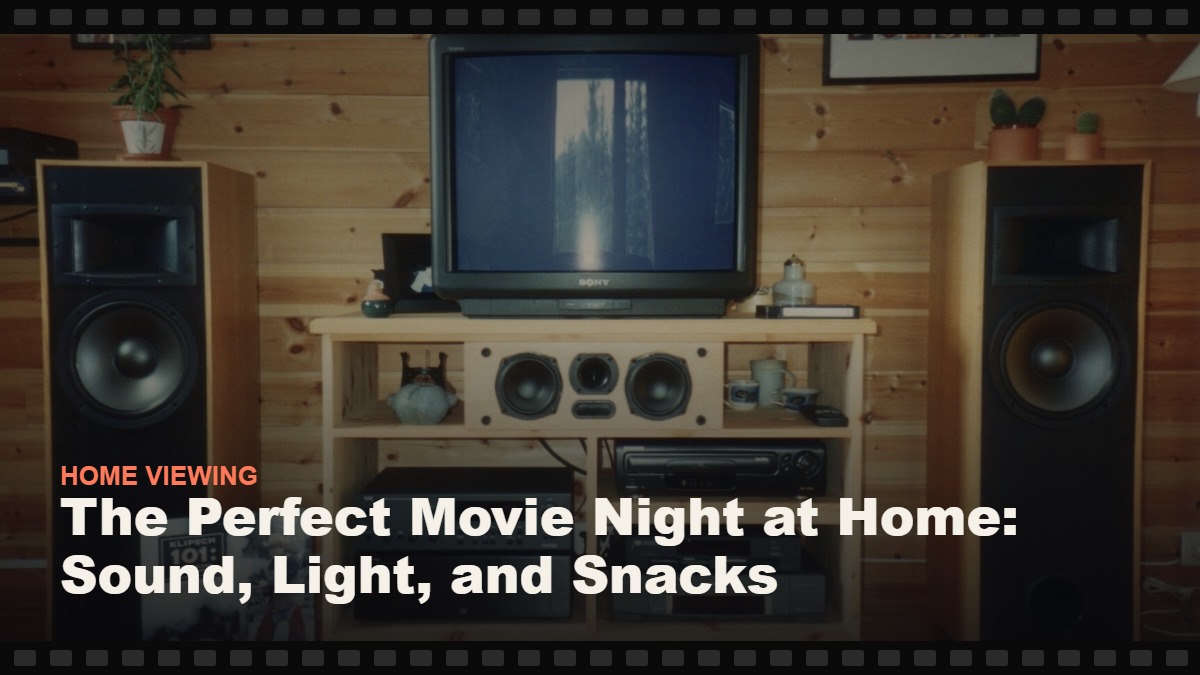
The Perfect Movie Night at Home: Sound, Light, and Snacks
The cinema’s magic is a set of deliberate conditions — darkness, scale, a social contract, an event frame — and every one is reproducible in a living room. The complete setup: light, sound, timing, snack engineering, and the five social rules.
Eighteen dollars buys a multiplex ticket and, with it, the things a theater does best: real darkness, big sound, a room of strangers laughing together, and a phone nobody’s allowed to touch. Home viewing usually fails at all four — half-watched films in half-lit rooms, interrupted by notifications every few minutes. The gap isn’t the equipment, though; it’s environment engineering. A cinema’s magic comes down to a set of deliberate conditions, and every one of them is reproducible in a living room for little or no money. What follows is the complete setup — light, sound, timing, snacks, and the social rules — a repeatable ritual that makes home the better venue, not just the cheaper one.
1.The Physics of Immersion (Why Cinemas Work)
Strip the cinema to its mechanisms and four things do the work. Darkness removes every competing stimulus — the screen becomes the only light source, and attention has nowhere else to go. Scale and sound fill your senses past the threshold where self-consciousness survives. The social contract — everyone’s phone is off by shared rule — protects the collective trance. And the event frame: a fixed start time, a ritual of arrival, the lights dimming on schedule. None of these is inherent to the building. All four are choices you can make at home, and the sections below are just those choices, specified.
2.Light: The Dark, Done Right
The home version of cinema darkness has one nuance: total blackness is actually harder on the eyes than a soft glow. The ideal is screen-only forward light plus gentle bias light behind the TV — the LED strip from our settings guide — which keeps contrast perceived-high and eyes comfortable for two hours. The kill-list: overhead lights (off, always), lamps in your peripheral view of the screen (off or moved), and the hallway glow leaking under doors. Daytime movie nights need real blackout measures; evening ones need only intention. The room rule that covers everything: nothing you can see should be brighter than the dark parts of the screen. One minute with that rule transforms the picture more than any TV setting.
3.Sound: Louder Than You Think, Clearer Than You Fear
Home viewers chronically under-play film audio, trained by apartment guilt and thin TV speakers. The cinema’s loudness is part of the spell — quiet scenes should be quiet and loud scenes should press — and the home version needs two things: a speaker system that renders dialogue clearly at cinema-adjacent levels (the tier-one soundbar from our home theater guide exists for exactly this), and the courage to set volume by the loud scenes, not the quiet ones. The apartment-friendly tools: dynamic range compression (“night mode”) squeezes the louds and lifts the quiets for shared-wall hours; subwoofer isolation pads keep the bass in your room rather than the neighbor’s ceiling. Sound done right is half the immersion — test it with any well-mixed scene and feel the room disappear.
4.Timing and Framing: Make It an Event
The cinema’s most underrated technology is the start time. Home’s version: a declared schedule — “film starts at 8:30” — with the ritual built around it. Snacks ready by 8:20, lights dimming at 8:28, and phones physically parked (a basket by the door is the household’s velvet rope). For films over two hours, plan the intermission like the old roadshow cinemas did: a natural lull around the midpoint, five minutes, drinks refreshed, theories exchanged. The intermission’s bad reputation comes from TV-length content; on a two-and-a-half-hour epic it’s a feature — attention resets, and the second half lands on a rested audience. Choosing the film itself is a solved problem if you keep the mood map bookmarked: name the room’s mood, shortlist three, veto one, start.
5.Snack Engineering: The Supporting Cast
Snacks are logistics and mood, and both reward small design. Popcorn first, obviously — our cinema popcorn guide replicates the theater taste exactly, including the butter that isn’t butter. The engineering details that matter: pre-portion into bowls before lights-down (mid-film kitchen trips break the spell), put drinks in stable containers (the carpet remembers), and match snack noise to the film — the crunch level of your spread should respect the quiet scenes. The signature move that elevates the evening: one themed touch — the cocktail from the film, the dessert that matches the setting, the candy you’d sneak into the multiplex made legal by your own kitchen. It costs a dollar and a minute, and it’s the detail guests recount later.
6.The Social Rules of the Home Cinema
The multiplex’s rulebook is implicit; the home’s needs five explicit lines, delivered warmly at the door:
- Phones parked — in the basket, not face-down on the cushion. The second screen is the only true enemy in this guide.
- Talk to the film, not over it — reactions are wanted; plot questions mid-scene wait for the intermission or the credits.
- Nobody spoils — the host confirms everyone’s spoiler status before the title is announced.
- The pause is sacred — pausing needs group consent; an unannounced pause is the home cinema’s phone-ringing-in-the-theater.
- Credits are the debrief — stay seated, let the score play out, and let the first reactions surface in the half-dark. The two minutes after the film are the best conversation of the night.
The Reelmonk Living Room Desk
7.The Ten-Minute Pre-Flight Checklist
Table 1 — Movie night, ready in ten minutes
| Check | The One Line |
|---|---|
| Film selected | Mood named, three shortlisted, one vetoed — done before anyone sits |
| Picture | Cinema mode confirmed; motion smoothing off (settings guide) |
| Sound | Volume set by a loud scene; night mode if the walls are thin |
| Light | Overheads off, bias light on, hallway door closed |
| Seating | Everyone within the screen’s good arc; blankets deployed |
| Snacks | Pre-portioned, drinks stable, trash bowl central |
| Phones | Basket by the door — house rule, lovingly enforced |
| Start time | Announced and kept — the event frame is the ritual |
8.The Ritual at Three Scales
The checklist flexes to the evening’s size. Solo night: the full ritual in miniature — phone exiled, lights right, one film chosen before dinner, snacks plated like they matter (they do). Couple’s night: the mood vote becomes a two-player negotiation (each nominates one, coin flip breaks ties), the intermission becomes the week’s best conversation, and the credits debrief is mandatory. The full house: eight friends, the checklist doubled, the snack table becomes a concession stand (assign it to the friend who loves that), and the host’s only real job is protecting the start time against the social gravity of a good kitchen conversation. Same physics at every scale: the conditions make the magic, and the conditions are cheap.
9.Seasonal Rituals: The Nights That Become Traditions
The movie night reaches its final form when the calendar owns it. The traditions worth stealing: the October horror run (one tension title a week, blankets mandatory, the mood map’s edge-of-seat column working overtime), the December classic (the household’s designated holiday film, same night every year, no substitutions), the new-year canon kickoff (January 2nd, the essential films ladder, week one), and the summer projector night (the garden annex from the tiers guide, weather permitting). Traditions work because they’re decisions you never have to remake — and a household with four fixed movie rituals has, functionally, its own small festival circuit.
10.The Remote Variant: Movie Night Over Distance
The ritual survives geography. The remote movie night — friends in different cities pressing play together — needs only three adjustments: a sync method (the services’ built-in watch-party features or a counted-down “3-2-1-play” on a call), a text or voice channel for reactions (the remote intermission happens in chat), and the same start-time discipline. What doesn’t transfer is the shared snack table; what transfers surprisingly well is the social contract — a remote room with parked phones and a fixed start feels far closer to cinema than to parallel scrolling. For long-distance friendships and dispersed families, the weekly remote watch is one of the great quiet rituals the streaming era actually invented.
11.Five Things That Kill a Movie Night
- The scroll start. Choosing after everyone sits is choosing to start at 9:47. Pre-select by the mood system before the evening begins.
- The half-lit room. “Just a small lamp” across from the screen halves the contrast. Light discipline is the cheapest upgrade in this guide.
- Volume anxiety. Quiet movies are watchable; loud-quiet-whiplash is not. Night mode exists; use it proudly.
- Kitchen expeditions mid-film. Everything pre-staged, or the intermission earns it.
- The second screen. One phone out and the room’s trance collapses; the basket rule is the whole ballgame.
12.Frequently Asked Questions
Does background music before the film matter?
It’s the lobby music of your cinema — a score playlist (the soundtrack guide supplies the material) at low volume during arrivals sets the evening’s register and smooths the transition to lights-down. One small environmental trick with an outsized effect: the night feels produced from the moment the door opens.
What films absolutely need the full ritual?
The sensory ones earn it most: the visually graded beauties (anything from the animation guide), the sound-designed epics, and the tension films whose spell is fragile. A comedy survives a bright kitchen; a horror film does not. Match the ritual’s strictness to the film’s demands — the checklist is a dial, not a law.
How is this different from the home theater guide?
That guide builds the hardware (tiers of gear and room); this one runs the evening (ritual, light, timing, snacks, rules). They’re halves of the same result: equipment provides capacity, the ritual provides immersion. A calibrated TV with the checklist beats a projector with a scrolling crowd.
Do themed decorations matter?
In moderation, wonderfully — a poster printed for the night, a menu card at the snack table, the household’s own “marquee.” The line to respect: decorations serve the ritual; they never delay it. Ten minutes of theme is charming; an hour of theme is a craft project that ate a movie night.
How early should guests arrive before the film?
Twenty minutes is the sweet spot — enough for hellos and snack-station traffic, short enough that the start time holds. The host’s line that keeps it friendly: “trailers at 8:25.” People respect a theater schedule from a friend when it’s announced as one, and the evening gains its frame.
What do I do about a guest who keeps talking?
The graceful tools: seat the talker next to the host (social containment), front-load the catch-up before lights-down (talk energy spent legally), and let the intermission absorb the overflow. If the film is genuinely discussion-prone — a mystery, a comedy — lean in: some films are better rowdy. The rules protect the trance; they don’t outlaw joy.
How do I pick a film for guests I don’t know well?
The unanimous-defaults principle from the mood guide: a crowd-proof pick (broad comedy, adventure, or a beloved classic) beats a personal favorite. Movie night with guests is hospitality, not curation — save the bold programming for the regulars, and let the mood map’s party row do its job.
Does the ritual work for one person?
It matters more solo: alone, the temptation to half-watch is highest and the ritual is the only enforcement. Phone in the other room, lights down, start time kept — the solo cinema night is a legitimate luxury and a perfect match for the canon ladder.
Should the host watch the film too?
Yes — the host who hovers breaks the spell they’re hosting. Set everything by the checklist, then sit down inside the ritual like a guest. The best hosts are invisible by 8:35: the lights are right, the snacks are stationed, and the room is watching a film, not being managed.
How do I keep it from becoming routine?
Ritual and novelty in alternation: the conditions stay fixed (start time, lights, rules) while the content rotates through the guides — a hidden gem week, a canon week, a double feature, a seasonal tradition. The night stays recognizable; the evening never repeats. When attendance flags, change the film, never the ritual.
What about kids’ movie nights?
The structure adapts beautifully: earlier start (7:00), the snack ritual doubled, the phone rule naturally irrelevant, and one addition — a “coming attractions” trailer slot (two trailers of next week’s candidates) that makes the ritual feel like the real cinema. Kids remember the event frame for years.
What about subtitles versus dubbing for mixed-language nights?
For a committed film night: subtitles, always — performance lives in the original voices. For a relaxed crowd with mixed reading stamina, a good dub on a crowd-pleaser beats a subtitle mutiny. The ritual’s rules don’t change either way; only the language track does.
What’s the one thing to start with tonight?
The phone basket and the announced start time. Both are free, both are immediate, and together they create the event frame that everything else decorates. The picture settings can wait for tomorrow; the trance cannot.
Weekly or occasional?
Weekly fixed slot if the household loves it — rituals survive on rhythm. Occasional event-nights work too, but they need the full checklist each time; the weekly one starts running itself by week three.
How do subtitles fit the ritual?
They earn their place: subtitle films deserve the full dark-room treatment, and the room helps — without competing light and phones, reading stops feeling like work by minute ten. The hosting rule for subtitle nights: nobody multitasks, and the font-size setting gets checked before guests arrive. The canon list’s world cinema section is the natural syllabus.
What if someone falls asleep?
The data point, not the disaster: note the film’s pacing and the start time. Chronic sleepers signal a mismatched slot (too late, too heavy a film for the hour) more often than a boring film. Move the start to 8:00, pick from the propulsive rows, and keep the blankets — a guest asleep under a blanket during act three is a hosting badge, not a failure.
Is it worth it without any hardware upgrades?
Completely — the free tier of the tiers guide plus this ritual is 80% of the cinema experience at 0% of the price. Hardware scales the last 20%; the ritual is the venue.
Sources & Related Reading
Companion guides on Reelmonk: picture settings, home theater tiers, cinema popcorn at home, and the film-selection mood map. Home cinema format reference: Dolby’s home entertainment hub (verified live at publication). Cover photo: Jan Hammershaug / Wikimedia Commons, CC BY 2.0.
The multiplex never had a monopoly on magic — just on conditions. Darkness, big sound, parked phones, a start time, and popcorn done right: five choices, one evening a week, and your living room becomes the best screen in town. Lights down at 8:28. See you at the credits. And when the room applauds — and with the right film and the right conditions, it will — you’ll know the multiplex was never the point. The ritual was.