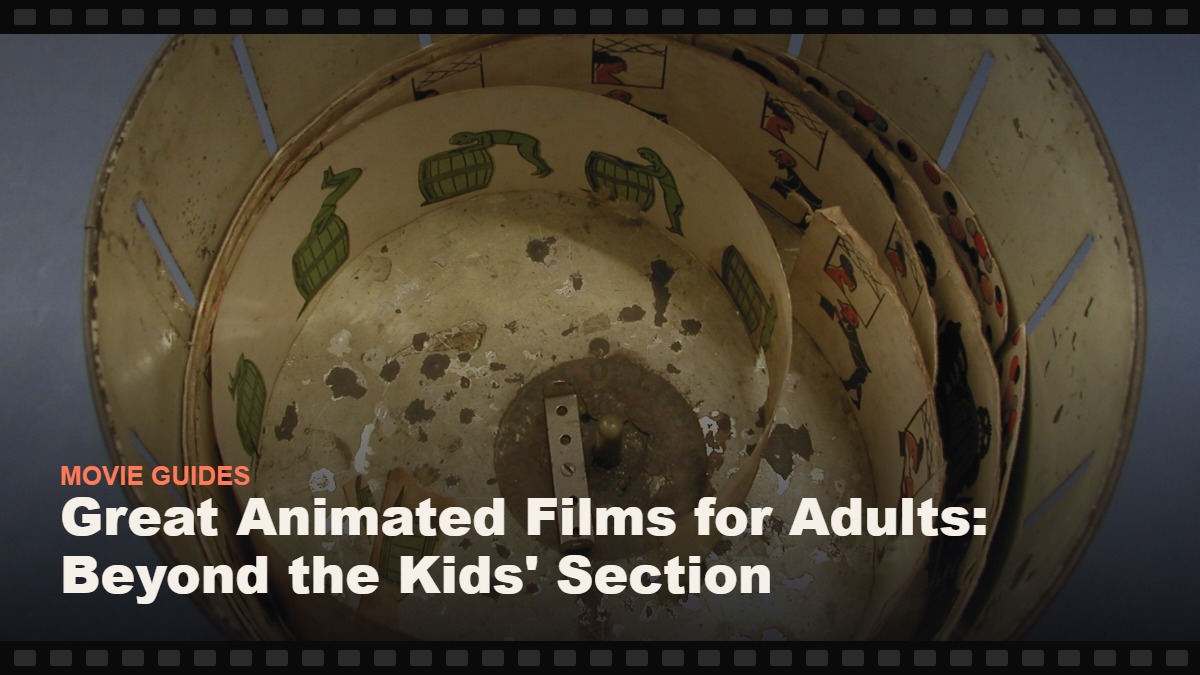
Great Animated Films for Adults: Beyond the Kids’ Section
Animation is a medium, not a genre — and it handles grief, memory, and dreams with a directness realism can’t reach. Twelve films that prove it, the skeptic’s four-week viewing path, and why the critical establishment converted long ago.
One of the stranger ideas in film culture took hold somewhere in the West: that animation is for children — a genre defined by talking animals and tie-in toys that adults tolerate at family gatherings and then outgrow. It’s a shame of an idea, and it has cost adult viewers some of the most moving, inventive, and beautiful films ever made. Animation isn’t a genre in the first place. It’s a medium — a way of making images — and in the hands of its masters it reaches places live-action physically can’t: memory, metaphor, dreams, the weightless logic of the imagination.
This guide is for adults ready to correct the oversight: twelve animated films that prove the point, organized by what each one does best, plus the viewing order that eases a skeptic in gently. No homework, no homework-adjacent worthiness — just twelve exceptional films that happen to be drawn, painted, or stop-motioned rather than photographed. Several come from the Studio Ghibli tradition — the studio’s catalog, celebrated at its official showcase, has done more than any other to teach adults what animation can hold.
1.What Animation Does That Live-Action Can’t
Three unique powers explain why so many masterpieces live in this medium. Total visual control: every frame in an animated film is designed from nothing — the light, the weather, the exact shade of a melancholy sky — so nothing on screen is accidental. Freedom from physics: animation moves between reality and metaphor without a seam; a character’s loneliness can literally swallow the frame. And time dilation: animated films compress years and expand seconds with a fluency live-action strains for. The result is a medium that handles the biggest subjects — grief, childhood, memory, mortality — with a directness that realism sometimes can’t reach. The films below are chosen as exhibits of these powers.
2.The Twelve, by What They Prove
Proving emotional depth
1. Grave of the Fireflies (1988). Two siblings in the final months of WWII Japan, told with unflinching tenderness. It is regularly cited as one of the greatest war films ever made — full stop, no animation asterisk — and it settles the “cartoons are for kids” question permanently in ninety minutes. Have the evening free; this one stays with you.
2. Up (2009). The first ten minutes — a wordless marriage compressed into a lifetime — are among the most celebrated sequences in modern cinema, and the film that follows honors them. Proof that mainstream animation can smuggle profound meditations on grief and renewal inside an adventure about a flying house.
3. Coco (2017). Pixar’s Day of the Dead journey into the Land of the Dead is a feast of color and music that lands on one of cinema’s great final scenes. Family audiences adore it; adults leave thinking about memory, legacy, and their grandparents. The two-level masterpiece, fully realized.
Proving artistic daring
4. Spirited Away (2001). Miyazaki’s bathhouse epic — a girl working in a resort for spirits — is the consensus summit of the medium: imagination so dense it feels documentary. Featured in our essential films guide and repeated here because no animation list is complete without it. Start your Ghibli journey here.
5. The Tale of the Princess Kaguya (2013). Studio Ghibli’s other master, Isao Takahata, drew this folktale in living watercolor — every frame visibly hand-made, every line alive. It may be the most beautiful animated film ever produced, and almost nobody outside the faithful has seen it.
6. Fantastic Planet (1973). The French-Czech psychedelic landmark: giant blue humanoids, tiny human pets, and a vision of alien life that half a century of sci-fi hasn’t caught up with. Strange, hypnotic, and historically essential — the proof that animation’s weird frontier is decades old.
Proving technique as wonder
7. Spider-Man: Into the Spider-Verse (2018). The film that reminded Hollywood that animation is a medium: comic-book panels, multiple art styles colliding frame to frame, and pure kinetic joy. Even viewers exhausted by superheroes report the same experience — the medium itself becomes the special effect.
8. Kubo and the Two Strings (2016). Stop-motion studio Laika’s peak: origami magic, a shamisen-wielding boy, and craftsmanship so extreme (three years animating) that the seams become the spectacle. The making-of material is worth a watch afterward — you’ll refuse to believe it’s physical.
9. I Lost My Body (2019). A severed hand escapes a laboratory and crosses Paris to find its body — and somehow this becomes a tender, beautiful film about love and fate. French animation’s modern miracle: a premise that sounds like horror, executed as poetry.
Proving range
10. Perfect Blue (1997). Satoshi Kon’s psychological thriller about a pop idol’s unraveling identity is genuinely unsettling adult cinema — so influential that Hollywood directors have been borrowing its imagery for decades. The definitive proof that animation handles psychological horror better than most live-action attempts.
11. My Neighbor Totoro (1988). The gentlest entry: two sisters, a new house, and the forest spirits next door. Nothing much happens, and it’s mesmerizing — the film that teaches attention as a pleasure. Adults watch it like a warm bath; it’s also the ideal bridge film for mixed-age rooms.
12. Waltz with Bashir (2008). An animated documentary about memory and the 1982 Lebanon war — the filmmaker interviewing his own vanished recollections, rendered in stark graphic style. The final cut to archival footage is one of the great gut-punches in documentary history, animated or otherwise.
3.The Twelve at a Glance
Table 1 — Match the film to your evening
| Film | Year | Tone | Content Note |
|---|---|---|---|
| My Neighbor Totoro | 1988 | Gentle wonder | All ages |
| Spirited Away | 2001 | Imaginative epic | Some scary moments for small kids |
| Up | 2009 | Joyful + moving | All ages (tissues advised) |
| Into the Spider-Verse | 2018 | Kinetic fun | All ages |
| Coco | 2017 | Warm fiesta | All ages |
| Kubo and the Two Strings | 2016 | Dark fairy tale | Older kids and up |
| I Lost My Body | 2019 | Tender + strange | Adults |
| Kaguya | 2013 | Watercolor elegy | Older kids and up |
| Grave of the Fireflies | 1988 | Devastating | Adults |
| Fantastic Planet | 1973 | Psychedelic allegory | Adults |
| Perfect Blue | 1997 | Psychological thriller | Strictly adults |
| Waltz with Bashir | 2008 | Animated documentary | Strictly adults (war themes) |
4.The Skeptic’s Viewing Path
For the animation-suspicious, order matters — lead with the films that meet existing tastes halfway:
- Week one: Into the Spider-Verse — pure kinetic pleasure; the “wait, animation can do THAT?” conversion moment.
- Week two: Spirited Away — the summit while momentum is high.
- Week three: Up or Coco — the emotional revelation: animated films can move you harder than live-action.
- Week four: I Lost My Body or Perfect Blue — the range proof, when the medium’s prestige is established.
By week four the question has usually inverted — from “why would adults watch animation?” to “what else have I been missing?” The answer: decades of it. The BFI’s greatest films poll has quietly ranked animated films among the all-time best for years; the critical establishment converted long ago. This guide just hands you the shortcut.
5.Beyond the Gateways: Three More Studios to Know
The twelve above are the front door; the building is enormous. Three names to follow next:
Cartoon Saloon, the Irish studio behind The Secret of Kells, Song of the Sea, and Wolfwalkers, draws from Celtic folklore with a visual style like illuminated manuscripts in motion — each film more confident than the last, and Wolfwalkers in particular belongs on any expanded version of this list.
Laika, beyond Kubo, built the modern stop-motion renaissance (Coraline, ParaNorman, Missing Link) — each frame a physical object moved by hand, twenty-four times a second, for years. Their work carries the handmade warmth that digital smoothness can’t imitate, and their behind-the-scenes footage is the best possible answer to “how is this made?”
The French pipeline — the school of I Lost My Body, Ernest & Celestine, and The Illusionist — specializes in the exact gap this article exists to close: animation conceived for adult sensibilities from the first storyboard. When the twelve are done, France is the country that keeps giving.
6.How to Watch Animation Well
Animated films reward a slightly different viewing attention than live-action, and two habits unlock it. First: watch the backgrounds. Since every element was drawn deliberately, the environment carries meaning — weather as mood, architecture as character. The pause-worthy frames are frequent; treat them like gallery visits rather than lapses. Second: listen to the sound design and score. Animated worlds build their entire sonic reality from nothing, and the craft is extraordinary — the bathhouse’s clamor in Spirited Away, the silence engineering of A Shaun the Sheep Movie, the drum-and-shamisen score of Kubo. Our soundtrack guide deepens the listening habit. Finally, give the credits a glance: the names of the animators and background artists are worth learning to follow, because in this medium, the auteurs draw.
7.Five Mistakes Newcomers Make
- Assuming “animated” means “for children.” The table’s content notes exist precisely because the range spans Totoro to Perfect Blue. Check the row, not the medium.
- Judging by the cover art. Marketing aims at families even when the film aims at everyone. Several of the twelve look cuddlier than they are — in both directions.
- Skipping the dubs debate entirely. For Ghibli and anime, subtitled originals preserve performance nuance; quality dubs exist and are legitimate for relaxed viewing. Try the original first, then decide by preference rather than dogma.
- Treating it as a side genre. Animation isn’t a detour from “real” cinema; it contains some of its peaks. Approach the twelve as cinema, and they deliver as cinema.
- Stopping at one studio. Pixar and Ghibli are gateways, not the whole map. Laika, Cartoon Saloon, and the French tradition all await beyond them.
8.Frequently Asked Questions
Why is animation so expensive and slow to produce?
Because nothing is photographed — everything is made. A hand-drawn feature requires tens of thousands of individual drawings; stop-motion moves physical puppets fractions of a millimeter per frame, twenty-four frames a second, for years. Understanding the labor changes the watching: every second of Kubo represents hours of a person’s hands. The medium’s slowness is precisely why its frames carry such density of intent.
Are there good animated short films for a quick taste?
The short format is animation’s laboratory — fifteen minutes, zero risk. Festival and award shortlists for animated shorts are the efficient discovery route, and the nominated packages that tour cinemas annually are a perfect sampler evening. Shorts also make superb film-club warm-ups before a feature.
Where should a total beginner start?
Spirited Away for the classic answer; Into the Spider-Verse for the modern one. Both convert skeptics inside twenty minutes, and both open different wings of the medium — hand-drawn tradition versus digital innovation.
Why does animation from other countries feel so different?
Because the medium globalized along different traditions: Japan built an industry where animation was always for everyone; France cultivated arthouse animation; America’s mainstream narrowed to family features before its recent re-expansion. Watching across traditions is a mini film-history education — the same tools, three different answers to what they’re for.
Are Studio Ghibli films connected? Do I need to watch in order?
No shared universe, no order required — each film stands alone. The loose progression most viewers enjoy: Totoro (gentleness), Spirited Away (the peak), Princess Mononoke (the epic), then Kaguya (the elegy) once you’re fluent in the studio’s language.
Do I need a special screen or setup for animation?
No special hardware — but animation is where a well-set screen shows off most: its deliberately designed color and line work pop on a calibrated picture. If you’ve never adjusted your TV out of its shop-demo mode, our picture settings guide is a ten-minute upgrade that these films will thank you for visibly.
What about adult animated TV?
The same revolution happened in series form — adult animation is one of television’s richest current veins. The discovery logic from our beyond-the-algorithm guide applies directly: follow the creators, not the thumbnails.
Is the medium growing or is this a golden-age-that-was?
Growing, decisively. The theatrical successes of the past decade — from Spider-Verse’s stylistic revolution to the international box office of Japanese animation — have pushed studios to fund adult-minded animation at unprecedented levels, and streaming has solved the distribution problem that once buried these films. The audience for grown-up animation has never had more to look forward to.
What if I want to learn animation myself?
Start with the twelve principles of animation (the craft’s founding document, born at Disney in the 1930s and still the curriculum) and free software — the hobby has never been more accessible. Fair warning from everyone who has tried: one week of animating a bouncing ball will permanently transform your awe at what the twelve films above achieved.
Why do some of these films hit adults harder than kids?
Because their real subjects are adult ones: memory, regret, responsibility, time. Animation’s distance from reality lets it approach heavy themes at an angle — the metaphor does the work. Kids see the adventure; adults see the year the adventure stands for. Both screenings are the real film.
What about anime series rather than films?
The film-first path is deliberate: features deliver complete experiences in an evening and calibrate your taste before the series’ longer commitments. When ready, the same directors’ TV work and the acclaimed limited series of the medium await — and the episode-guide approach from our limited series guide maps neatly onto them.
What’s the single most beautiful one to show on a good TV?
Princess Kaguya for hand-made watercolor warmth, or Spider-Verse for sheer visual fireworks — the two poles of what animation can look like. Either makes the case for the medium in the first thirty seconds, and both reward the biggest screen and darkest room you can offer them.
Are any of these good for a date night?
Several: I Lost My Body and In-the-mood-for-wonder titles like Totoro share beautifully; Coco and Up generate the best post-film conversations; and Spider-Verse is the unanimous crowd-pleaser. The date-night rule from our mood guide holds: match the film to the evening’s energy, not to its reputation.
Is animation “real cinema” for film-club purposes?
Absolutely — several of the twelve are film-club gold precisely because the medium choice itself becomes a discussion topic. Pair Grave of the Fireflies with a live-action war film, or Perfect Blue with its live-action descendants, and the conversation writes itself.
Sources & Further Reading
Studio heritage: the Studio Ghibli collection; canonical standing: the BFI Sight & Sound poll. All links verified live at publication. Related: the 25 essential films and twelve hidden gems for your next twelve evenings. Cover photo: Auckland Museum / Wikimedia Commons, CC BY 4.0.
The door animation opens doesn’t close again. Twelve films, four weeks, one corrected assumption — and a whole second cinema, running parallel to the one you knew, is yours. Start tonight; the bathhouse is open. And somewhere around the third film — when a painted sky makes you feel more than a photographed one ever has — the question will have fully inverted: not whether animation can be for adults, but how you went this long without it.