The Art of the Movie Soundtrack: Why Music Makes the Scene
Mute the score and any great scene drains flat. How film music steers the brain, the five techniques composers use on you, the five composer traditions worth following, and the listening practice that changes how you watch.
Try this tonight: mute the score during any great scene and notice what drains out of it. The shower scene without strings is just plumbing. The helicopter ride without Wagner is just traffic. Film music is the most powerful and least-discussed layer of cinema — an emotional guidance system so effective that audiences almost never consciously register it, which is exactly how it’s designed to work. Composer Bernard Herrmann (Psycho, Vertigo) called music on screen “the communicating link” between film and audience; a century of filmgoing has proven him right more times than anyone’s bothered to count.
This guide teaches you to hear what you’ve been feeling: how film music actually works on the brain, the five techniques composers use to steer you, the great composer traditions worth following, and a listening practice that will permanently change how you watch movies. The craft’s recorded history is wonderfully documented at FilmSound.org, the reference archive for sound in cinema.
1.Why Music Works on Film: The Emotional Shortcut
Music reaches emotion faster than dialogue ever can, for neurological reasons: melodic and harmonic patterns trigger emotional responses directly, bypassing the language processing that words require. Filmmakers exploit this ruthlessly and benignly. A scene’s meaning is often genuinely ambiguous on the page — two people at a table — and the score tells you whether it’s menacing or tender before a word lands. Test it consciously once: during any drama, ask “what is the music telling me about what I’m seeing?” The answer is usually the scene’s actual thesis, delivered subliminally. This is why directors guard their composers jealously: the score is where the film’s emotional intent is encoded.
2.The Five Techniques That Steer You
Table 1 — The composer’s toolkit
| Technique | What It Does | Where You’ve Felt It |
|---|---|---|
| Leitmotif | A recurring theme tied to a character, place, or idea — its return tells you what the scene is really about | Every saga you’ve loved; the two notes that mean a shark |
| Ostinato | A repeating figure that builds tension by not resolving | Chase scenes, heists, countdown dread |
| Stinger | A sudden musical jolt synced to a reveal | Every jump scare; Psycho’s shower |
| Source music (diegetic) | Music the characters can hear — radios, bands, jukeboxes | Needle drops; the diner scene’s jukebox |
| Silence | The withheld score — absence as emphasis | No Country for Old Men’s scoreless dread |
Leitmotif — the oldest and mightiest technique, inherited from opera — deserves the spotlight: attach a melody to an idea, then vary it, and the audience tracks the story with their ears alone. The love theme swelling when a character thinks of someone; the villain’s motif creeping under a scene he’s not in — you’ve been reading these cues your whole moviegoing life without naming them. And note the fifth entry: the deliberate absence of music, wielded by confident directors, is the technique that teaches you the value of all the others.
3.Anatomy of a Cue: How a Scene Gets Scored
Between “the cut is locked” and “the audience feels it,” a single scene’s music passes through a fixed craft sequence. Watching for its fingerprints makes you a connoisseur of the small scale:
Table 2 — One cue, start to finish
| Step | What Happens |
|---|---|
| Spotting session | Director and composer watch the cut together and decide where music starts, stops, and what each cue must feel — the score’s blueprint meeting |
| The temp track problem | The editor’s placeholder music has already been living in the cut for months; the composer must satisfy the film and escape the temp’s shadow at once |
| Writing to picture | The cue is composed to the frame — hits, turns, and emotional pivots timed to the tenth of a second |
| Mockup & approval | A digital demo is played against the scene; the director signs off (or doesn’t — cue rewrites are the norm) |
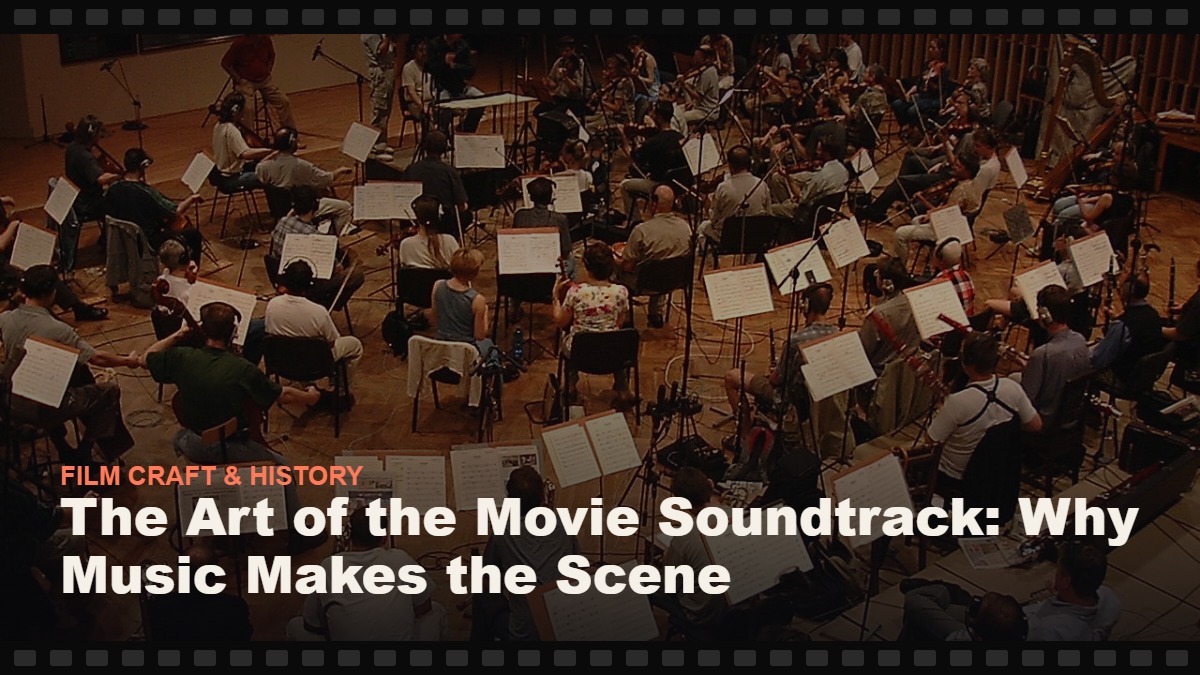
| The session | Orchestra records to the film projected live, click tracks in every headphone — hours of music per day, no second takes on the calendar |
| The mix | The cue is balanced against dialogue and effects; a great cue mixed too loud becomes a problem, mixed right becomes emotion |
The compression to remember: this entire pipeline often runs in four to eight weeks for a full feature. The film-score schedule is one of the great under-sung feats of deadline craft in any art form — which is why film composers speak of time the way surgeons speak of it.
4.Beyond the Score: The Whole Sonic World
The soundtrack you’ve learned to hear is only one layer of a film’s sound; the full stack includes sound design (the engine roars, the alien shrieks, the room tones) and the mix that braids everything together. The distinction matters for listening practice: when a scene’s power comes from sound effects — the docking sequence’s groaning metal, the lightsaber’s hum — you’re hearing the sound designer’s craft rather than the composer’s, and the great films braid the two until they blur (several famous “score” moments are actually sound design pitched like music). Our credits guide maps who’s responsible for which layer. The complete listener eventually hears all three registers at once — music, design, silence — the way a conductor hears sections of an orchestra.
5.The Needle Drop: When Pop Songs Do the Scoring
The alternative tradition replaces the composed score with existing songs — the “needle drop” — and its masters (Scorsese, Tarantino, Wes Anderson) use pop music as time machine, counterpoint, and joke engine. The mechanics differ from score: a song brings its own history, so the scene gains layers the filmmaker didn’t have to write — “Stuck in the Middle with You” over violence is funny and horrifying precisely because of everything the song normally means. The economics are real too: licensing famous songs costs serious money, which is why a jukebox-heavy soundtrack signals either a big budget or a director with powerful friendships. When a needle drop lands perfectly, the song and the film fuse permanently — you’ll never hear one without the other again.
6.The Composer Traditions Worth Following
Film music has auteurs as distinct as directors, and learning five names transforms your listening:
Table 3 — Five compositional voices to know
| Composer | The Signature | Essential Listen |
|---|---|---|
| Max Steiner | The Golden Age’s lush wall-to-wall romanticism — the man who essentially invented the Hollywood score | Casablanca; King Kong (1933) |
| Bernard Herrmann | Hitchcock’s darker nerve — strings as anxiety, motifs as obsession | Psycho; Vertigo |
| Ennio Morricone | The Italian master — whistling, electric guitar, and operatic loneliness in the desert | The Good, the Bad and the Ugly |
| John Williams | The leitmotif’s modern emperor — a theme for everyone, hummable by everyone | Star Wars; Jaws; E.T. |
| Hans Zimmer | The modern maximalist — synthesizer-orchestra hybrids, the braaam era, and rhythmic minimalism | Inception; Interstellar |
The listening path writes itself: one album each, in chronological order, and you can hear the art form’s whole evolution — orchestral lushness to psychological minimalism to pop fusion to electronic grandeur. Beyond the five, the current generation is deep: the jazz-inflected experiments, the avant-electronica of the streaming era, and international traditions from Bollywood to anime scores each reward a dive. The craft’s institutional memory is kept by archives like FilmSound.org and by the renaissance of soundtrack vinyl, which has made scores collectible objects again.
7.The Listening Practice: Hear It On Purpose
Four habits train the ear without turning movie night into homework:
- The mute test (once). Watch a favorite scene with the sound off, then again with it on. The delta is the score’s workload — seeing it once calibrates your hearing forever.
- Name the technique aloud. “Leitmotif,” “stinger,” “needle drop” — labeling as you watch converts passive absorption into active hearing within a few films.
- Albums without the film. Great scores stand alone; listening to a score on a walk lets you hear the architecture the picture usually covers.
- Follow the composer’s name, not just the director’s. The credit at the end — “Music by” — is the beginning of a thread worth pulling: favorite composers reliably lead you to films you’d never have found, a discovery channel the gem-hunting guide would endorse.
The Reelmonk Craft Desk
8.Five Soundtrack Myths
- “Good music is music you don’t notice.” Half true — invisible scoring is one school; Herrmann, Morricone, and the needle-drop tradition prove that foreground music is another, equally valid.
- “Scores are written before filming.” Almost never — composers write to the locked cut, scene by scene, on punishing schedules measured in weeks.
- “The composer conducts the orchestra.” Sometimes; often a separate conductor leads while the composer supervises from the booth.
- “Temp tracks are harmless.” The temp track (existing music cut into the edit) is the industry’s secret dictator — many famous scores exist because a director fell in love with the temp and the composer was asked to orbit it.
- “Soundtrack albums are souvenirs.” They’re standalone works: the best are sequenced by the composer as albums, and the vinyl revival has made them a collecting genre of their own.
9.Frequently Asked Questions
Why does the same music feel different in the cinema than at home?
Scale and physics: a theater’s speaker array and volume let low frequencies hit your body while the darkened room removes competing stimuli. Home listening compresses both. It’s the strongest practical argument in this guide’s family for the setup articles on our Home Viewing desk — decent speakers and a calibrated room return a surprising share of the cinema’s sonic scale.
What should I listen for on a first “active” viewing?
Three checkpoints: the main title (the score’s thesis statement), the first emotional pivot (how the music tells you what to feel), and the climax (whether the score swells, strips back, or — boldest — disappears). That trio alone teaches you more about a film’s intentions than a dozen reviews, and it takes zero preparation beyond deciding to listen.
How do composers get hired?
Through relationships and demos: directors return to trusted collaborators (the famous director-composer partnerships are the craft’s recurring love stories), and newer composers break in via shorts, games, and TV before features. The composer’s reel works exactly like a director’s: the evidence of feeling created on demand.
What’s the difference between score and soundtrack?
Score is the composed instrumental music written for the film; soundtrack technically means the film’s whole audio — and commercially means the album, which may feature songs, score, or both. When someone says “the soundtrack was great,” they usually mean the needle drops; when they hum the theme, that’s score.
Who picks the songs in a needle-drop-heavy film?
Usually the director with a music supervisor — a dedicated role that combines taste, licensing law, and budget negotiation. The great needle-drop films are auteur statements twice over: the film, and its playlist.
Do composers see the finished film before writing?
They see a near-final cut — the “locked” picture from the production pipeline in our how movies are made guide — because every cue must hit its marks to the tenth of a second. Composers writing blind to a script is a myth; the craft is composition to the image, which is why picture lock is the score’s true starting gun.
Why do modern trailers all sound the same?
Because trailer music is its own industry: specialist houses compose “trailer cues” optimized for ninety-second escalation (the slowed-down cover song, the horn of doom). The film’s actual score is usually irrelevant to its trailer — which is why trailers so often misrepresent the film’s music entirely.
Are there great film scores in animated movies?
Some of the greatest — animation relies on music even more heavily, since the sound world is built from zero. The scores behind the films in our animation guide include several modern masterpieces of the craft, from Ghibli’s gentle waltzes to the orchestral sweep of the Pixar tradition.
What are “source cues” and why do credits list so many songs?
Every piece of music audible in the film — including the three seconds from a passing car radio — must be licensed or composed, and every one is logged in the credits. That block of song titles near the end of the roll is a legal document as much as a playlist: it’s where the music supervisor’s year of negotiation becomes visible.
Is film music “real” classical music?
The question is a century old and settled in practice: film scores are performed by the world’s great orchestras, studied in conservatories, and fill concert halls on their own programs. Whatever the category label, the craft’s demands — emotion on a deadline, to the frame — have produced some of the most performed orchestral music of the modern era.
Can a score save a bad film?
It can redeem one — several famously mediocre films live on through magnificent scores — but it can’t repair structure. The composer’s own joke: “I can make a bad film worse slower.” The score amplifies what’s there; it can’t invent what isn’t.
Why do some scenes use silence instead of music?
Because silence is the loudest statement a score can make. A film that’s been wrapped in music suddenly dropping to bare room tone makes audiences lean in involuntarily — the ear searches for guidance and finds none, which is exactly the vulnerability the director wants. The technique’s masters use it as a scalpel: when music finally returns after long silence, it lands twice as hard.
Can I use film-score listening to focus or work?
You’d be in enormous company: instrumental scores are the internet’s favorite concentration music precisely because they’re engineered to support attention without hijacking it. A score written to sit under two hours of dialogue sits beautifully under two hours of work — the craft’s functional secret, hiding in plain sight on every focus playlist.
Where should a beginner start listening?
One album each from the five composers in Table 2, in order — a self-contained history course you can finish in a week of commutes. Then chase the “Music by” credit from your own favorite films; personal love is the best curriculum there is.
Sources & Further Reading
Craft archive: FilmSound.org, the reference library for cinema sound. Related on Reelmonk: who’s who in the credits and the essential films guide — every film on that list has a score worth this article’s attention.
The tradition you’re joining is older than sound film itself — silent cinema was never silent; it came with pianists, organs, and full orchestras. A century later, the instinct is unchanged: pictures want music the way stories want listeners.
You’ll never un-hear it now: the motif that returns, the silence that screams, the jukebox song that means three things at once. Film music was always doing this to you — the only change is that now you’re in on it. And a century of great scores, freshly legible, is waiting on your walk to work. And the mute test awaits you tonight — one favorite scene, sound off, then on. The scene will be the same; you’ll never watch it the same way again.